
 By Byeong
If we look at the book Reopening the Back Door by Kenneth Haugk, the founder of Stephen Ministry, we find an important distinction between the gifts needed for those who provide direct pastoral care and those who lead and manage the ministry.
Kenneth Haugk explains that people who care for others need gifts such as compassion, mercy, encouragement, and empathy. On the other hand, those who oversee and guide the ministry need gifts such as leadership, teaching, administration, and vision.
This distinction is generally true, but in many local churches we often see the opposite. Some senior pastors naturally excel in caring for people but are less gifted in organizing or leading a ministry. Likewise, some lay pastors or lay leaders possess strong leadership, teaching, and administrative abilities. This should not be viewed as a problem. Instead, pastors should recognize these different gifts and assign responsibilities accordingly. Those with leadership gifts can serve as shepherd leaders or become members of the Ministry Leadership Group (MLG), where their abilities can be used effectively.
Some people demonstrate what might be called soft leadership. They lead by love, compassion, and personal example rather than through administration or organizational skills. I once met the senior pastor of a university church who confessed that he had a strong teaching gift but very little confidence in pastoral care. He was concerned that this was a weakness. I explained that this is exactly why Lay Pastors are so valuable. Lay Pastors complement the senior pastor by exercising gifts of compassion and personal care, while the senior pastor can concentrate on teaching, equipping, and providing spiritual direction. His teaching gift was not a disadvantage—it was one of his greatest strengths as the leader of the ministry.
In every healthy ministry, there are leaders and caregivers. One primarily leads and equips; the other primarily ministers directly to people. These are different functions, yet both are essential. When each person serves according to his or her God-given calling, the church becomes healthier and stronger.
Dr. Melvin Steinbron often emphasized that these two groups of gifts are generally different. Most people naturally lean toward either caring or equipping, rather than excelling equally in both. Certainly, there are exceptional individuals who possess both gifts, but they are the exception rather than the rule.
When someone possesses both caring and leadership gifts, it is truly a special grace from God. Nevertheless, most believers have one primary area of gifting. The key is not to wish for another person’s gifts but to faithfully develop and maximize the gifts God has already given.
God gives spiritual gifts, but He also expects us to cultivate them. Developing our gifts through study, experience, training, and faithful service is our responsibility. Gifts are given by God’s grace, but maturity in using those gifts comes through diligent practice.
The distinction between caring and equipping can be summarized this way:
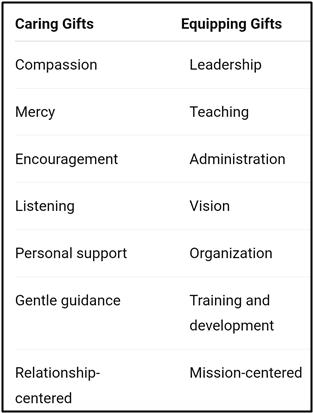
Caring ministry is generally warm, relational, gentle, and nurturing. Equipping ministry is more structured, disciplined, instructional, and strategic. Neither is superior to the other. Both are necessary, and together they reflect the fullness of Christ’s ministry.
In some respects, this relationship resembles the concept of yin and yang—soft and firm, love and discipline, nurture and instruction. While this analogy is not theological, it illustrates how two complementary strengths work together to produce balance.
Senior pastors should understand this principle well. Rather than expecting every leader to possess every gift, they should recognize the diversity of gifts within the Body of Christ and allow each person to serve where God has gifted them most. When caring and equipping ministries work together in harmony, the church becomes healthier, stronger, and more effective in fulfilling Christ’s mission.